

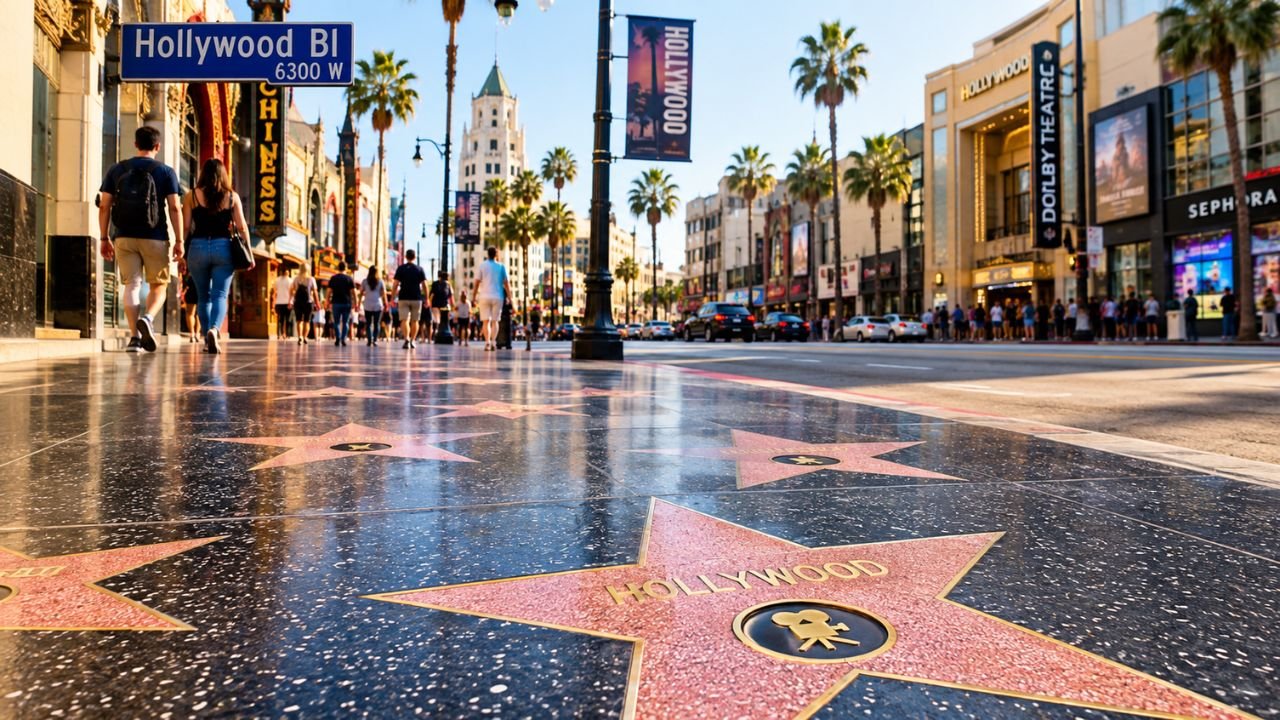
The Hollywood Walk of Fame is arguably the most famous landmark in Los Angeles and one of the best known symbols of worldwide show business. The Walk of Fame is located on Hollywood Boulevard and Vine Street as the iconic attraction honors individuals for their achievements in film, television, music, radio, and live performance. With its unmistakable terrazzo stars, the Walk lures millions of visitors who desire to see their favorite personal amateur inscriptions and so wishes in more adoration gleaned from Hollywood’s dragological past.
What Is the Hollywood Walk of Fame?
The Hollywood Walk of Fame is a landmark consisting of more than 2,650 brass and terrazzo five-pointed stars embedded in the sidewalks along fifteen blocks of Hollywood Boulevard and three blocks of Vine Street. It’s not your typical museum or a glorified tourist trap — it immerses you in history on the very streets of Hollywood where this entertainment legacy unfolded. Every star holds the name of the honoree and an icon denoting the specific category in which he or she is being recognized. The sight has thus become a prominent aspect of Los Angeles tourism and popular culture.
The stars can basically be found on Hollywood Boulevard and Vine Street. While many visitors only associate the attraction with film stars, the Walk of Fame consists of performing arts and also actors from multiple different genres. The representatives can be musicians, television personalities, radio professionals, stage performers and filmmakers. This diverse array is one of the reasons that makes the attraction remains a point of interest for guests across years and cultures. Operation through which readers may receive the opportunity to catch up with additional celebrity and entertainment-related fun facts, The Magazine Bio can also provide engagement situations on well-known people in pop culture — their life stories, careers, achievements or contributions.
The Hollywood Walk of Fame and Whoopi Goldberg
The Hollywood Walk Of Fame has its beginnings with the 1950s when civic leaders and members of the Hollywood community began to talk about honoring the entertainment industries contributions to their area. While Hollywood had long been a center of international film and celebrity culture, local leaders wanted a permanent fixture that would honor entertainment figures while also positively impacting and rejuvenating the character of the Boulevard.
The Hollywood Chamber of Commerce was heavily engaged in developing the project. Eventually, the concept was turned into the reality of stars embedded within sidewalks for an attraction. Work on the site started in the late 1950s, with the first fixed stars installed in 1960. Since that point, the Walk of Fame has steadily grown with new inductees.
For over six decades now, thus the attraction developed. The list of honorees has evolved over the years to reflect trends in entertainment, as television, recorded music, radio and live performance have grown in importance. This Walk of Fame is no longer just an historical project from classic Hollywood, but instead a working recognition system honoring new entertainment milestones today.
The Reason Behind The Creation Of Hollywood Walk Of Fame
The Hollywood Walk of Fame, the tourist trunk line for all things celebrity, was designed to honor those who had made important contributions to entertainment and create a unique civic icon for Hollywood. In the 1950s, Hollywood was searching for its identity and ways of capturing more press. The permanent tribute to personnel in the entertainment industry created an opportunity to bridge the area’s history with its burgeoning tourism sector.
The project also gave us something outstanding visually. Rather than burying recognition in some awards shows, newspapers or entertainment publications, the names of those who matter would be permanently written into the streetscape. This concept led to the development of Hollywood Boulevard as an outdoor tribute to entertainment history.
Fast forward a whole career later and an idea that was a cute little story made for pancakes has grown into much more. The Hollywood Walk of Fame became and remains a place where tourists can, literally, touch celebrity history. Tourists can traverse the exact pavements, while taking pics of famous names and learning about stars from various ranges of entertainment.
Where to Find the Hollywood Walk of Fame
Hollywood Walk of Fame From Wikipedia, the free encyclopedia Jump to navigationJump to search For other uses, see Walk of fame (disambiguation). The stars are laid out along portions of Hollywood Boulevard and Vine Street, not compacted into a single building or an enclosed entertainment complex. It is unlike going to a museum because the experience includes walking through the surrounding streets where one encounters stars along the way.
Hollywood Boulevard is especially the most liked as it is adjacent to many other backdrop places and famous attractions. When you visit the Walk of Fame, you can combine it with local theaters, entertainment venues, shopping areas, restaurants and other Hollywood destinations. This is ideal for tourists who wish to check many attractions in one go.
The Walk of Fame is quite large, so if people are interested in certain stars, they should know where to find them before they come. And some forethought goes a long way in locating favorite stars without wasting time roaming busy sidewalks hunting them down.
Hollywood Walk of Fame Categories
Hollywood Walk of Fame: This honors accomplishments in more than one major branch of showbiz entertainment. Each star features an emblem representing the category in which the recipient has notability. It trains visitors to understand the reason behind a particular individual’s star and proves that the attraction is so much more than just cinema.
| Category | Symbol | What It Recognizes |
| Motion Pictures | Film camera | Contributions to the movie industry |
| Television | Television set | Achievements in television |
| Recording | Phonograph record | Contributions to recorded music |
| Radio | Radio microphone | Achievements in radio |
| Live Theatre/Performance | Comedy and tragedy masks | Stage and live entertainment |
Each of these categories would let the landmark represent different parts of the entertainment world. Those stopping by might spot the star of a legendary actor, then be greeted with one for an iconic musician or television host just up the way. The categories together provide a somewhat comprehensive account of entertainment history.
Motion Pictures Stars
Hollywood has ranged and historically been mostly identified with filmmaking, too, so it’s no surprise that the motion-picture category is among the most recognizable portions of The Hollywood Walk of Fame. Stars in this category honour people whose careers have contributed to cinema significantly. While actors are the most high-profile recipients, it can also be other key filmmakers who work with movies.
Over the years, generations of movie stars have been synonymous with eras of cinema. Names linked to iconic Hollywood, legendary directors, global stars, and modern entertainment surface during a visitor’s journey. Which makes for an especially interesting category to those who enjoy learning about film development and celebrity culture after the fact.
Television Stars
Television is one of the most significant entertainment features globally, so this looks celebrated with a dedicated television category on the Hollywood Walk of Fame. Television stars are entertainers and other professionals in television who have made significant contributions to the medium’s influence. The category is a nod to the way TV revolutionized entertainment by beaming performers (and programming) directly into homes.
The television area also illustrates alterations in the definitions of celebrity. Previous generations mostly associated fame with cinema, but over the years television has birthed some of popular culture’s most famous faces. Given that many of today’s successful television performers can attract huge global audiences, this is a significant area of the Walk of Fame.
Recording Stars
The recording category honors individuals and groups who have made substantial contributions to the field of recorded music. This works as an award to recognize achievements of singers, musicians and other recording artists. It is especially attractive to music lovers because it links famous artists with a real, tangible site that can be visited in person.
Over the years, music has come a long way from when the first stars were installed in 1960. Genre and generation is the aesthetic evolution of popular culture from earlier forms of popular music and rock to styles further developed into modern music. The stars of the record industry thus offer a fascinating snapshot of the development of musical taste and the entertainment business.
Radio Stars
Radio was one of the Nation’s earliest forms of mass communication which helped shape modern day entertainment and broadcasting prior to Television. Hollywood Walk of Fame — radio in the Hollywood Walk of Fame honors personalities and people working in fictional and non-fictional audio.).
Even with the rise of streaming platforms and social media, radio is sometimes seen as an old fashioned form of entertainment but still holds a lot of sway. It established idol personas, mainstream music programs, comedy shorts or podcasts, interviews and other formats that shaped future entertainment domains. The establishment of awards and other honorifics to recognize radio professionals catalogs a meaningful sliver of that history.
Live Theatre and Performance Stars
That the live theatre and performance category shows that the Hollywood Walk of Fame is more than just screen-based entertainment. The award recognizes notable contributions in the field of live performances and those linked with informal performances or public displays.
Live entertainment has existed for a long time and always will play an integral part in pop-cultural society. Unlike filmed entertainment which has editing and production techniques that can manipulate time, space and wardrobe (for better or worse), performers have to reach the audience live. Walk of Fame Includes Live Performance As A Category, Recognizing Talent and Impact of Performers Whose Careers Have Been Defined By Audiences Experiencing Work In Person
How Does One Receive a Star on the Hollywood Walk of Fame?
Contrary to popular belief, getting a star on the Hollywood Walk of Fame isn’t just something you get for becoming famous; it’s an actual award. There is a formal selection process in which individuals are nominated and considered. The recognition is tied to accomplishments in terms of professional achievements and business impact, as well as contributions to entertainment.
It also demonstrates the concept of public interest and a person´s relationship with their professional field. After a person has been chosen, arrangements can occur for the installation and public ceremony relating to the honor. Traditionally, the presence of the recipient at the ceremony has been an integral part of celebrating earning the award.
The process works to keep the stars feeling preserved. Selection is an ancient way of saying that some acclaim, celebrity and fame are ‘better’ than others; to curating such a long list as these thousands of famous names already comprise in modernity can seem absurd for those not appearing on it, or at least without your own publicist in your team automatically making this decisions for you.
Hollywood Walk of Fame Stars
The names of Hollywood Walk Of Fame’s many legends from various generations of entertainment. Visitors can see stars for those associated with film, television, music as well as sports and other categories. Several famous names associated with the landmark include Marilyn Monroe, Elvis Presley, Frank Sinatra, Walt Disney, Michael Jackson, Tom Hanks and several More Stars.
The diversity of the honorees makes the attraction intriguing. A visitor with an interest in classic cinema might search by stars from Hollywood’s classic age, whereas music fans may want to narrow the search to iconic recording artists. TV fans can discover stars linked to the best television shows and personalities.
The Walk of Fame is not just one single era — it encompasses names from decades. The landmark maintains its ties with the past while adding to this roster of contemporary entertainment for new honorees.
The Hollywood Walk of Fame How Many Stars Are There?
You are updated until October 2023.The Hollywood Walk of Fame has expanded considerably since the initial stars were placed in 1960. Today, there are over 2,800 stars and that number continues to fluctuate as new honorees are announced and selected.
Every individual star has a standard design that contains the recipient’s name and the category of achievement. While the people represented on it are from an extremely disparate cross-section of entertainment, this uniformity makes for a recognizable Walk of Fame visual identity.
The ballooning count of stars also means that it will be impossible for any visitor to see all names in a short time. If you have certain celebrities that you want to see, pre-plan your visit and decide what sections and stars you’re interested in checking out prior to the actual event.
Is the Hollywood Walk of Fame free?
The Hollywood Walk of Fame is nice because anyone can stroll along the public sidewalks and view the stars without needing to shell out for a general admission ticket. Unlike standard tourist attractions, there is no entry gate to pass through or a single building for visitors to enter.
But travelers need to realize Hollywood also comes at a cost. Parking, guided tours, other area attractions, food and drink, shopping, and entertainment experiences may all incur separate charges — depending on their availability. Transportation and crowd conditions around the area should also be kept in mind for visitors wanting to attend a special star ceremony.
Although the Walk of Fame is still free and openly accessible to anyone, this makes it tidier for tourists wanting to see one of LA’s most obviously over-the-top sights without buying into an expensive attraction.
Hollywood Walk of Fame Visiting Hours
You can visit the Hollywood Walk of Fame year-round, but when you go really depends on the experience you’re after. Those who wish for quieter environments and better chances of photographs may feel more comfortable early in the morning. At the end of the day, Hollywood Boulevard is usually a vibrant place to roam but crowds make it difficult to take decent photos or walk.
Themes and unique entertainment events can change the atmosphere completely too. When a star is revealed, visitors might find a line of media set up, fans gathered and be able to learn about the festivities taking place. People who are into entertainment events might get excited with this, but travelers looking for leisurely touristy day tours should keep an eye out for that.
Hollywood Walk of Fame Visitor Tips
Some simple planning makes it easy to visit the Hollywood Walk of Fame. As the attraction covers a large part of Hollywood, having comfortable shoes can be very beneficial for visitors that plan on locating multiple individual stars.
Some practical tips include:
- Star: If you are going to photograph stars, write down the ones you want to do before starting the walk.
- Wear comfy shoes: You will do a lot of walking as you get to explore the different sections.
- Keep an eye on your belongings: Hollywood can get very busy, so take regular tourist precautions.
- Visit nearby attractions: Combine the Walk of Fame with other Hollywood landmarks for a more complete day.
- Give yourself additional time: The area can take longer to navigate than you enter the crowd and traffic.
Such preparations help tourists minimise the time of figuring out how to go around and spend more time doing things.
The Hollywood Walk of Fame and Hollywood Celebrity Culture
This is very significant in connection with the first point; since there is celebrity galore around Hollywood and the stage to showcase these importantes goes many extra miles, hence why this landmark continues to be a global recognizable. Hollywood has always stood for fame, thirst for stardom, movies, music and show business. The stars make that physical manifestation of the abstract concept of celebrity visible to visitors so they can snap a photo and see the name.
It can be unnervingly familiar to see a star’s name on the sidewalk for fans. Or those who come just to find the star of a beloved (or hated) actor, singer, musician, or TV personality. By now we know that social media has made these visits more conspicuous, since travelers are always posting pictures and videos from Hollywood Boulevard.
With entertainment continuing to adapt, celebrity culture follows suit. Yet the Walk of Fame is still a tangible monument in an ephemeral era, offering a generation-spanning marker for stars from an industry where success may vanish as quickly as it appears on social media (or at least feel like it).
Cultural Significance of the Hollywood Walk of Fame
Much of its cultural significance comes from the fact that it preserves a wide record of entertainment history in open view to the public. The stars have been assigned to various decades, genres, professions and entertainment forms. Glancing down the names lining Hollywood Boulevard can thus lend a visual chronology of how pop culture has evolved through the decades.
The landmark is also a reflection of the relationship between entertainment and tourism. Hollywood has its identity and its association with the stars that helped to make such a mark on it globally. The Walk of Fame materialises that history and makes it available in a voyeuristic exploration of sorts with the names placed out in the open for all to see.
Thus its significance goes far beyond just celebrity images. It is a living tribute that lives and breathes to commemorate the entertainers who have touched viewers globally.
Hollywood Walk of Fame vs. Other Hollywood Attractions
The Hollywood Walk Virginia reel and similar tourist attractions in Hometown Hollywood are often stories that you are nearby, however the Walk to be competent feel different for new ones. Compared to attractions emphasizing exhibits, film history, architecture, or live entertainment, the Walk of Fame is primarily an outdoor public tribute.
You can take your time exploring it due to the open-air format. You do not have to spend a set amount of hours in a museum or stick closely to the path at all. Visitors passing through can walk up the sidewalk, look for specific names, pose for a few photos and move on about their day in the neighborhood.
This flexibility allows for simple combinations of the Walk of Fame with other attractions. Travelers may construct an itinerary in which the obsession with entertainment history extends to sightseeing (Stars on Hollywood Boulevard), shopping, dining, and photography; it is possible not to treat the Walk of Fame as a disjoint full-day activity.
What Makes the Hollywood Walk of Fame So Successful?
The Hollywood Walk of Fame will remain popular because it combines history, celebrity recognition, accessibility and location. Not many tourist sites host you walking right next to the names of so many celebrities from show business. It is a simple experience but paired with global popular culture gives it lasting appeal.
That landmark may also evolve over time. New stars emerge, your entertainment taste changes and newer generations discover the artists where they were in awe. For the tourist that toured the area a few decades ago, a trip to Hollywood today would have vastly different stars one was interested in.
One of the Walk of Fame’s greatest strengths is this ability to unite generations. It keeps a record of past amusements while still reveling in the lives of contemporary stars.
Closing Thoughts on the Hollywood Walk of Fame
The Hollywood Walk of Fame is still one of the iconic aspects of Los Angeles as well as the Entertainment industry. A work in progress since the 1950s and home to its first stars by 1960, it has evolved into a major international tourist destination and lasting memorial to those working in show business.
It is important for its diversity. The landmark is not just reserved for movie stars. Its categories span motion pictures, television and recording (which includes music), radio, and live theatre or performance creating a far wider range of entertainment history. And thousands of stars now link generations of performing talent with one of Hollywood’s most active and best-known boulevards.
To a visitor to Los Angeles, the experience is really simple yet unforgettable: walk along Hollywood Boulevard, see familiar names, take pictures and look around. And for those of us who follow entertainment, it gives us something more meaningful—one last chance to see a physical manifestation of our heroes and the people behind the scenes who made pop culture possible.
In the end, the Hollywood Walk of Fame still represents a generations-long status quo between Hollywood, celebrityhood, entertainment and recognition from the public. Those stars may be embedded in the sidewalks, but those names have become part of the lore of entertainment.
FAQs
1. What is the Hollywood Walk of Fame?
The Hollywood Walk of Fame is a famous Los Angeles landmark that honors notable personalities from movies, television, music, radio, and live entertainment.
2. Where is the Hollywood Walk of Fame located?
The Hollywood Walk of Fame is located along Hollywood Boulevard and Vine Street in Hollywood, Los Angeles, California.
3. How many stars are on the Hollywood Walk of Fame?
There are more than 2,800 stars honoring individuals and groups for their contributions to different areas of the entertainment industry.
4. Is the Hollywood Walk of Fame free to visit?
Yes, visitors can walk along the public sidewalks and view the stars without paying an admission fee.
5. How does someone get a star on the Hollywood Walk of Fame?
Candidates are nominated and reviewed through an official selection process that considers their professional achievements and contributions to entertainment.